Sign film is a practical sourcing term used by sign shops, distributors and wide-format printers for printable or plotter-cut adhesive materials. Buyers also search the joined spelling signfilm, but a purchase order still needs a precise construction: face film, adhesive, release liner, surface finish, printable coating, width and intended application.
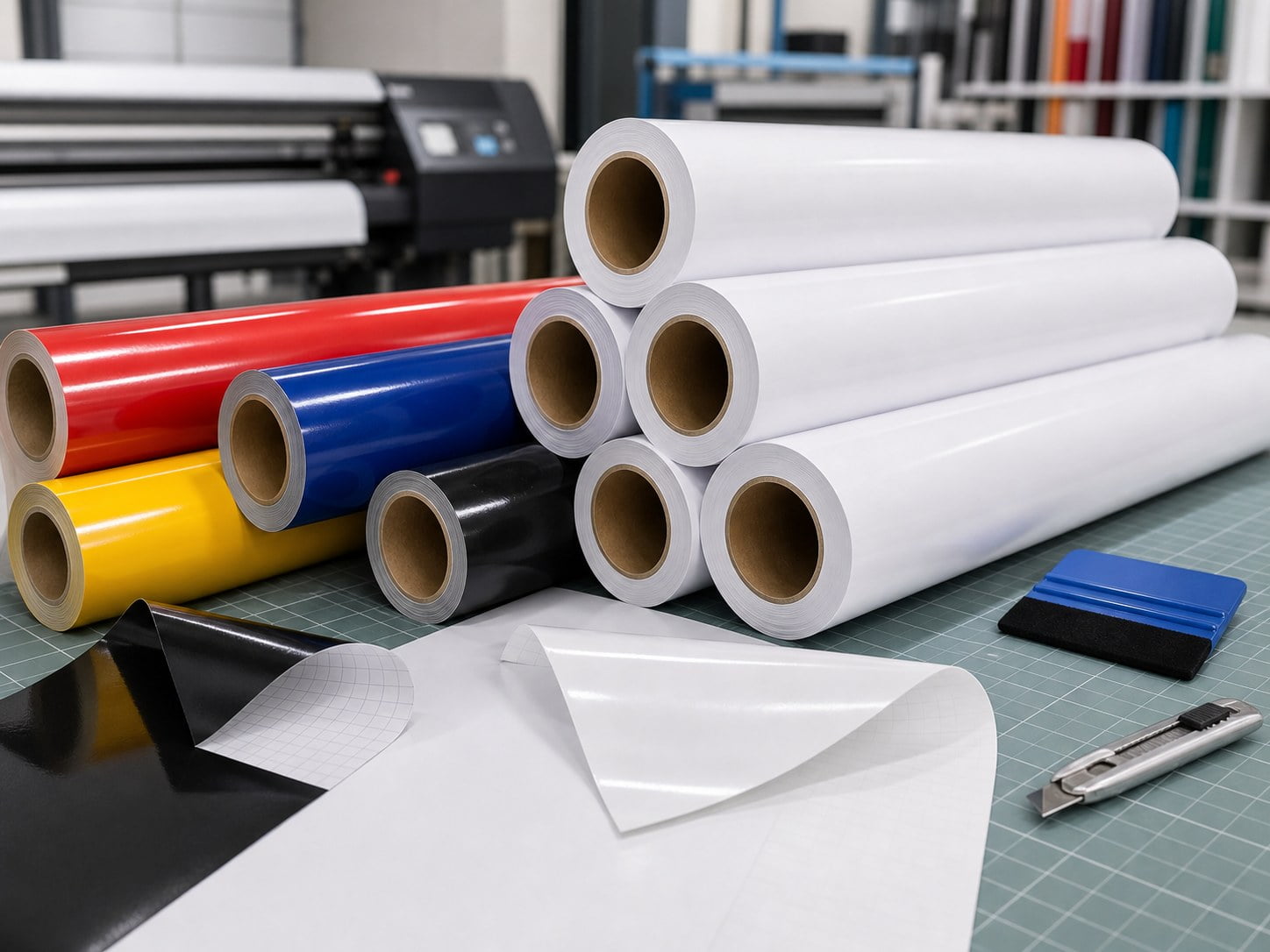
This buyer guide explains how sign film relates to self-adhesive vinyl and how to compare monomeric, polymeric, cast, color cutting, one way vision and protective films. It is written for importers and printing-material distributors who need repeatable quality rather than a one-line price by roll.
What buyers mean by sign film
In day-to-day trade, sign film can mean any thin graphic film used to produce signs, labels, windows, vehicle graphics or promotional displays. A printer may use the phrase for white printable vinyl, while a sign maker may mean colored plotter film. A distributor may use it as an umbrella category that includes printable vinyl, perforated window film and overlamination film.
The safest purchasing approach is to treat sign film as the application family and then specify the exact material. This avoids common errors such as ordering a rigid calendered film for deep vehicle channels, choosing a permanent adhesive for a temporary campaign, or pairing a laminate with a face film that shrinks at a different rate.
Sign film material comparison
| Material type | Typical construction | Best applications | Main buyer checks |
|---|---|---|---|
| Monomeric printable vinyl | Calendered PVC face film with printable coating | Flat panels, indoor promotions, short- to medium-term signs | Shrinkage, adhesive option, liner flatness and ink drying |
| Polymeric printable vinyl | More stable calendered PVC with polymeric plasticizers | Longer outdoor graphics and gentle curves | Dimensional stability, outdoor durability and matching laminate |
| Cast wrapping film | Thin cast PVC designed for conformability | Vehicle wraps, rivets, channels and complex curves | Conformability, repositioning, air release and removal |
| Color cutting vinyl | Pigmented face film for plotter cutting | Lettering, logos, wayfinding and decorative graphics | Color consistency, weeding, cutting and transfer tape |
| One way vision film | Perforated white/black film | Storefront and vehicle-window graphics | Open area, perforation quality, print density and local window rules |
| Lamination film | Clear protective pressure-sensitive film | Protecting printed sign film | Finish, UV protection, adhesive clarity and shrinkage compatibility |
The seven specifications that prevent sign film claims
- Face-film construction: State monomeric, polymeric or cast instead of relying only on total thickness.
- Adhesive system: Confirm permanent, removable, clear, grey, black, high-tack or air-release requirements and the intended surface.
- Release liner: Check paper weight, PE coating, lay-flat performance, release stability and whether the liner supports contour cutting.
- Ink compatibility: Name the actual eco-solvent, solvent, latex or UV printer and test curing before bulk purchase.
- Surface finish: Gloss, matte and special textures change color appearance, glare and lamination choice.
- Roll dimensions: Confirm usable width, length tolerance, core size, splice policy and telescoping control.
- Application life: Separate expected outdoor exposure from removability. A film can remain bonded yet become difficult to remove cleanly.
How adhesive choice changes the finished graphic
Adhesive is often more important than face-film thickness. A standard permanent adhesive can work well on smooth painted metal, glass and common sign boards. High-tack adhesive may be needed for low-energy plastics or textured surfaces, but it also increases installation difficulty and removal risk. Removable adhesive is useful for short campaigns, although removability still depends on exposure time, temperature, surface condition and chemical contact.
Grey or black adhesive can improve opacity when graphics must cover an existing image or dark substrate. Clear adhesive is preferred when the graphic needs light transmission or when the adhesive side remains visible. Air-release channels can make installation faster, but buyers should test whether the channel pattern suits the target printer, lamination pressure and application method.
Print and lamination compatibility
A sign film that prints well in one system may need different curing or profiling in another. Too much solvent retained in the print can soften the adhesive and cause edge curl after lamination. UV ink can create a comparatively rigid ink layer, which matters when the film is stretched around curves. Latex printing depends on heat tolerance and complete drying.
For outdoor graphics, use a laminate with similar dimensional behavior and the required finish. A low-shrink face film paired with a more unstable laminate can curl at the edges. Test the complete stack: printer, ink, profile, outgassing time, laminate, application tape and substrate.
Sample test checklist for distributors
| Test | Method | Pass indicator |
|---|---|---|
| Print surface | Print solid colors, gradients and small text | Even color, clean dots and no coating failure |
| Ink drying | Use the intended production profile and curing settings | No blocking, smearing or adhesive softening |
| Initial tack | Apply to representative glass, board, metal or plastic | Controllable positioning with secure edge contact |
| Liner release | Cut sheets and contour-cut samples | Stable release without liner curl or premature separation |
| Shrinkage | Measure printed and laminated panels after heat and time exposure | Movement remains within the agreed project tolerance |
| Removal | Age samples under realistic heat and sunlight | Removal behavior matches the campaign requirement |
| Packing | Inspect roll edges, core, wrap and carton after transport simulation | No telescoping, crushed edges or moisture damage |
Choosing sign film by application
For flat promotional signs, start with a cost-effective printable self-adhesive vinyl and select the adhesive by campaign duration. For retail windows, decide whether the project needs solid printable film, transparent film, frosted film or one way vision film. For plotter-cut lettering, use color cutting vinyl with suitable transfer tape. For vehicle curves, use a conformable grade designed for wrapping rather than assuming every printable vinyl can stretch.
Distributors should organize stock by application and risk, not just by price. An economy monomeric SKU can serve everyday flat graphics, while a more stable polymeric option covers customers who need longer outdoor life. Specialty products such as one way vision, high-tack vinyl and wrapping film should have clear sample labels and separate technical sheets.
Export packing and order information
Roll media claims often begin with packaging damage rather than coating failure. Specify core strength, inner moisture protection, end caps, outer carton or kraft paper, label position and pallet requirements. Wide rolls need particular protection against crushed edges and telescoping. The quotation should state net width, roll length, rolls per pallet and container loading estimate.
For a useful quotation, send the target country, application, substrate, printer and ink, required width and length, monthly demand, adhesive preference, expected outdoor life and packing method. These details let OSIGN recommend a practical sample instead of sending an unrelated generic film.
Buyer FAQ
Is sign film the same as self-adhesive vinyl?
Sign film is a broad buyer term that can include printable self-adhesive vinyl, color cutting vinyl, window film and specialty graphic films. Self-adhesive vinyl is the most common printable sign film, but the two phrases are not always identical in a purchasing specification.
Which sign film is suitable for short-term promotions?
A monomeric calendered vinyl with a removable or standard permanent adhesive is commonly selected for short-term indoor graphics and flat outdoor signs. The exact choice depends on removal expectations, surface energy, climate and campaign duration.
When should a buyer choose polymeric or cast film?
Polymeric film is generally preferred for longer outdoor use and moderate curves. Cast film is selected for demanding vehicle wraps, rivets, deep channels and applications where low shrinkage and conformability are critical.
What should be included in a sign film sample test?
Test print quality, ink drying, lamination compatibility, initial tack, repositioning, edge lift, liner release, shrinkage and clean removal on the actual substrate whenever possible.
Can one sign film be used with eco-solvent, solvent, latex and UV printers?
Some films support several ink systems, but buyers should confirm the coating and run a sample on the exact printer, ink and laminator combination before ordering production quantities.
How should export rolls be packed?
Use a straight, moisture-protected roll with a strong core, end protection and an outer carton or kraft wrap. Wide or heavy rolls may need pallet protection to prevent crushed edges during international transport.
Related OSIGN pages: Vinyl Sticker | Self-Adhesive Vinyl | Color Cutting Vinyl | One Way Vision | Application Guide | Request Samples
Request sign film samples and specifications
Tell OSIGN the substrate, application, printer, ink, roll width, expected life and monthly demand. We can recommend a matching printable film, adhesive, liner and export packing option.
Share this article



Leave a Reply