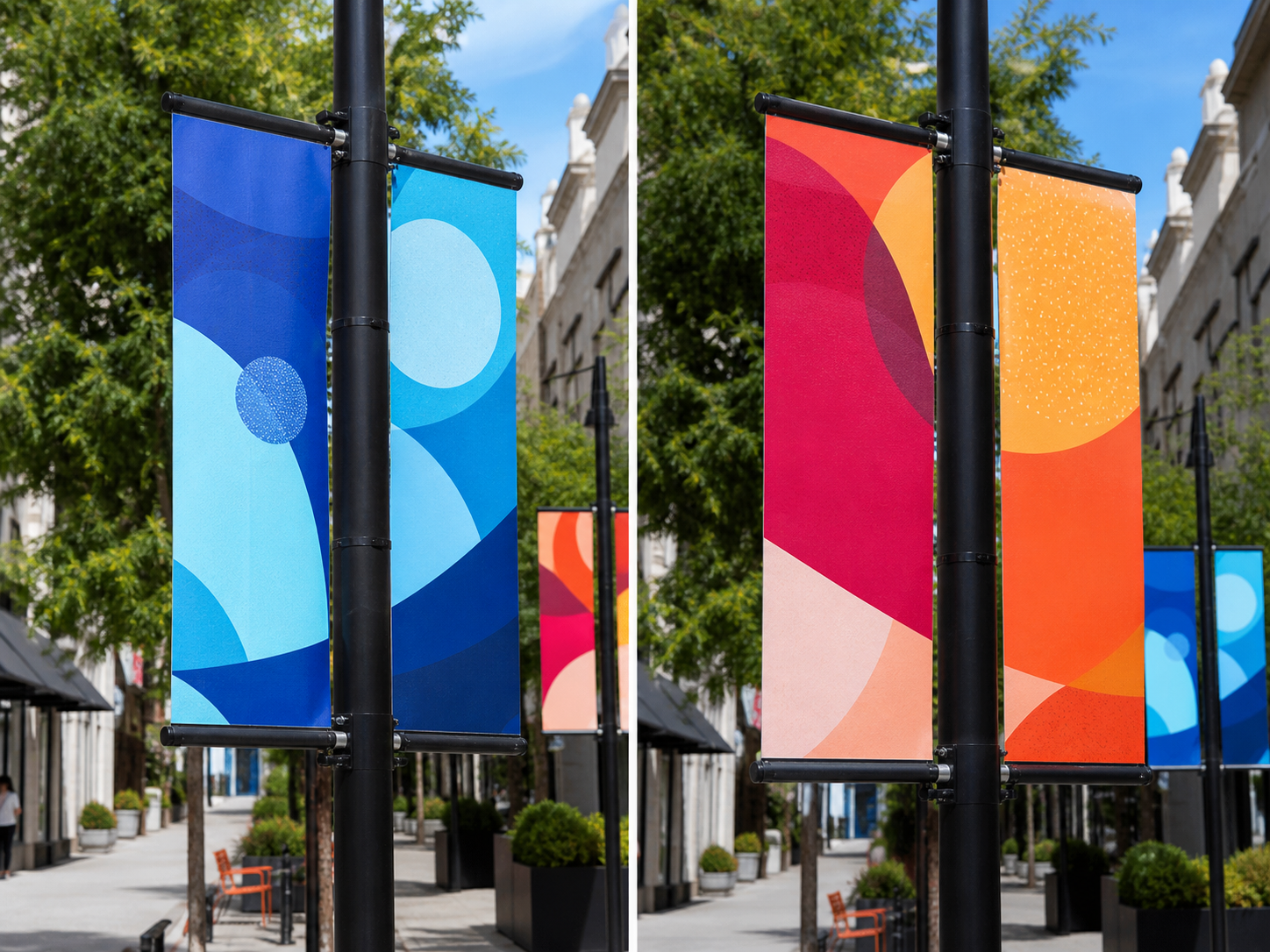
Blockout PVC banner is specified when a printed graphic must remain opaque under daylight, artificial lighting or two-sided viewing. The material is commonly used for street-pole banners, hanging signs, event graphics, retail displays and temporary barriers where ordinary frontlit banner may allow the structure or reverse image to show through.
For importers, the phrase blockout PVC banner is not a complete specification. Buyers still need to define whether the product is printable on one or two sides, the required opacity, base-fabric strength, total weight, surface finish, compatible ink, roll width and final fabrication method. This guide gives distributors and print businesses a practical checklist for comparing quotations and approving samples.
How blockout PVC banner creates opacity
A blockout banner normally uses an opaque middle construction to reduce light transmission. In a double-sided grade, printable white PVC layers sit on both sides of a dark blocking layer. In a one-sided grey-back or black-back product, the colored backing hides the substrate or an existing image, but the back surface may not be intended for printing.
Opacity is influenced by the formulation, coating thickness, color and uniformity of the blocking layer. A heavier roll is not automatically more opaque, and a highly opaque sample is not automatically suitable for double-sided printing. Both outer surfaces must accept ink consistently, and the complete structure must remain balanced enough to resist curling.
Blockout banner construction comparison
| Material type | Printable sides | Main purpose | Buyer caution |
|---|---|---|---|
| Double-sided blockout banner | Two | Street-pole banners, hanging signs and reversible graphics | Confirm both sides have equal print quality and adequate image separation. |
| Grey-back banner | Usually one | Covering existing graphics and improving opacity on light-colored substrates | Do not assume the grey reverse is printable. |
| Black-back banner | Usually one | High-opacity wall, panel and event graphics | Check whether the dark back can mark light mounting surfaces. |
| Standard frontlit banner | Usually one | General billboards, fence signs and promotional banners | It may transmit light or show shadows when the background is bright. |
| Blockout display fabric | One or two depending on grade | Indoor SEG, exhibition and backdrop systems | This is textile, not PVC banner; finishing and print methods differ. |
Core specifications to place on the purchase order
- Printable construction: State one-sided or double-sided and request a printed sample from both surfaces.
- Opacity target: Define the project lighting and an agreed test method instead of using the word blockout alone.
- Total weight and tolerance: Record nominal GSM and acceptable production tolerance by roll or batch.
- Base fabric: Confirm yarn, density and tensile/tear expectations for the finished sign size.
- Surface: Specify gloss or matte, whiteness, smoothness and whether the two sides must match.
- Ink compatibility: Name solvent, eco-solvent, latex or UV and test ink adhesion plus curing on both sides.
- Roll dimensions: Confirm usable width, length, core size, winding direction, splice policy and edge quality.
- Finishing: State hem, weld, pole pocket, sewing or grommet requirements and test the selected method.
- Compliance: Ask for the applicable flame-retardant or chemical documentation when the project or market requires it.
- Export packing: Define moisture protection, end caps, outer carton or kraft wrap, labels and pallet option.
Blockout PVC banner vs frontlit banner
| Decision point | Blockout PVC banner | Frontlit banner |
|---|---|---|
| Light transmission | Designed to be opaque | Can allow some light and background shadow |
| Two-sided graphics | Available in printable double-sided constructions | Normally intended for one printed face |
| Typical application | Street poles, hanging signs, retail dividers and reversible displays | Billboards, fences, events and everyday outdoor signs |
| Weight and handling | Often heavier and stiffer depending on construction | Broader economy-to-premium weight range |
| Cost | Higher when a blocking layer and two printable surfaces are required | Usually lower for comparable everyday grades |
| Main quality test | Opacity, side-to-side print balance and curl | Surface printability, strength and outdoor durability |
For general one-sided outdoor advertising, the Frontlit Banner category is usually the economical starting point. Choose Blockout Banner when opacity, background masking or separate artwork on both sides is essential.
Sample testing for double-sided printing
A white unprinted sample cannot prove how the material will behave in production. Print a dark image or solid color on side A, allow the ink to cure fully, and then print a different high-contrast image on side B. Inspect the result under daylight, transmitted artificial light and the actual viewing distance. Check whether image show-through changes after the material is tensioned or fabricated.
Measure curl and dimensional movement after printing both sides. Uneven ink load, curing heat or coating balance can make the graphic roll toward one face. If the banner will be folded, welded or sewn, produce a finished miniature sample and test the hem, pocket or grommet area rather than evaluating only the center of the sheet.
Blockout banner test and approval table
| Test | How to evaluate | What approval should confirm |
|---|---|---|
| Opacity | Use a strong light or high-contrast pattern behind the banner | No distracting shadow or reverse-image show-through |
| Two-side print | Print different dark artwork on both faces | Stable color and clear separation of the two designs |
| Ink adhesion | Cure, rub and tape-test the intended ink system | No coating lift, smearing or weak adhesion |
| Curl and shrinkage | Measure before and after two-sided printing and heat exposure | Finished graphic remains within project tolerance |
| Tear and finishing | Weld, sew, hem or grommet a representative sample | Edge construction supports the expected installation load |
| Roll quality | Unwind the production width and inspect edges and surface | No telescoping, blocking, wrinkles or crushed edges |
| Outdoor suitability | Expose a printed sample to the intended climate where practical | Color, adhesion and structure match the campaign duration |
Best applications for blockout PVC banner
Double-sided blockout banner is especially useful for street-pole banners, ceiling-hung retail graphics, shopping-center signs, event wayfinding, double-sided fence panels and temporary outdoor displays viewed from opposite directions. One-sided blockout versions work well when installers need to cover an old advertisement, a dark wall or a frame that would otherwise remain visible through the print.
For tall pole banners and exposed outdoor locations, the fabric strength and bracket system matter as much as opacity. Wind load increases quickly with sign area, and a solid blockout sheet does not release air like mesh. The installer should confirm the banner size, hardware, pole pocket, reinforcement and safe wind conditions.
Flame-retardant and indoor project requirements
Exhibition halls, shopping centers and public venues may request flame-retardant documentation. The required standard varies by country, venue and project. Buyers should name the required test method before quotation and confirm that the supplied batch and supporting report match the tender requirement. A generic statement such as flame resistant is not a substitute for the requested documentation.
Export packing and quotation checklist
Blockout PVC banner can be heavier than standard promotional banner, so the core and end protection need to support the full roll. Ask for moisture-resistant inner wrapping, strong end caps, a suitable outer carton or kraft wrap and pallet protection for long-distance transport. Labels should identify item code, batch, width, length, weight and printable side or winding direction.
For a useful quotation, provide the application, one- or two-sided printing requirement, target GSM, width and length, printer and ink, finish, monthly quantity, flame-retardant requirement, destination port and packing preference. This information helps OSIGN recommend a relevant grade and sample rather than quoting an unrelated opaque banner.
Buyer FAQ
What is blockout PVC banner?
Blockout PVC banner is an opaque printable banner material with a light-blocking inner layer or backing. It is used when buyers need to stop light transmission, hide the structure behind a graphic or print different artwork on two sides.
Can every blockout banner be printed on both sides?
No. Double-sided printing requires two printable outer surfaces with sufficient opacity between them. A grey-back or black-back one-sided banner can block the image behind it but may not be designed for printing on the reverse side.
What GSM is common for double-sided blockout banner?
The appropriate weight depends on construction, width, wind exposure and finishing. Buyers should compare base-fabric strength, coating balance and opacity together with GSM rather than choosing by weight alone.
Which ink systems can print blockout PVC banner?
Many grades support solvent, eco-solvent, UV or latex printing, but the two printable sides can have different curing behavior. Test the actual printer, ink and profile before a production order.
Is blockout banner suitable for street-pole banners?
Yes, double-sided blockout banner is widely used for street-pole graphics because opposing images remain separated. The finished banner still needs suitable hems, pockets, brackets and wind-load planning.
How should opacity be tested?
Place a strong light source or high-contrast pattern behind the material and inspect both dry and printed samples. For double-sided work, print different dark graphics on each side and check show-through under the expected installation lighting.
Can OSIGN provide samples for two-sided printing tests?
Yes. Send the target printer, ink, width, finishing method and application. OSIGN can prepare a relevant blockout PVC banner sample for print, opacity and fabrication testing.
Related OSIGN pages: Blockout Banner Products | PVC Banner Category | Frontlit Banner | Frontlit vs Backlit Guide | PVC Banner Buying Guide | Request a Quote
Request blockout PVC banner samples
Send OSIGN your printer, ink, roll width, application, finishing method and monthly demand. We can recommend a blockout banner grade for opacity, one- or two-sided printing and export packing tests.
Share this article


Leave a Reply